
India is among the three least-favoured Asian stock markets, according to BofA Securities whose survey found that 10 per cent of fund managers are underweight on Indian equities from a 12-month perspective.

India and the US are expected to have smooth trade negotiations after US President Donald Trump and Indian Prime Minister Narendra Modi had a productive meeting during Modi's visit to the White House last month, Stephen A Schwarzman, chairman, chief executive officer, and co-founder of one of the world's largest alternative investment firms, Blackstone Group, said in Mumbai on Wednesday.

India's Venture Capital (VC) ecosystem exhibited robust growth in 2024, with funding surging 43 per cent year-on-year to $13.7 billion, according to a report. This recovery was fuelled by a 45 per cent rise in deal activity, with 1,270 transactions recorded, reinforcing India's position as the second largest market for venture capital and growth funding in the Asia-Pacific region, the report by Bain & Company and IVCA said.

'That refresh programme -- because they are big aircraft and we cannot ground them all at the same time -- will last well into 2027.'

India on track to be third largest consumer economy by 2025.

The last time this happened was in 1996.

India's services sector activity eased slightly in March, weighed down by a marginal slowdown in sales amid softer demand conditions and easing inflationary pressures, a monthly survey said on Friday. The seasonally adjusted HSBC India Services PMI Business Activity Index fell from February's reading of 59.0 to 58.5 in March, but remained above its long-run average of 54.2.

Asia's richest man Mukesh Ambani on Thursday said his oil-to-telecom-and-retail conglomerate is not seeking short-term profit but is in the business of creating wealth for the nation. Speaking at the company's annual shareholder meeting, he said all businesses of Reliance Industries Ltd continue to be key drivers of the Indian economy and have become a success story. "We are not in the business of pursuing short-term profit and hoarding wealth. "We are in the business of creating wealth for India," he said.

For Indian parents, sending a child abroad for a three-year degree could deplete 48% of their retirement savings, while a four-year degree may consume up to 64%.

Days before Diwali, the monthly economic review by the finance ministry has highlighted moderation in urban demand, softening consumer sentiments and limited footfall as areas that need to be watched. In its review, released on Monday, the ministry also noted the early signs of artificial intelligence displacing workers, as described in anecdotal reports. The commentary from several large consumer goods companies, including Nestl India, Hindustan Unilever, and ITC, in their recent quarterly earnings, has been around a sluggish urban demand. Rural consumption, however, has mostly seen a revival, the companies pointed out.

10 largecaps stocks which stand to gain from the Budget.

'My advice: Don't mark your portfolio to market every day. Focus on survival.'

'Consider 40% to 50% in equities, 10% in gold as a hedge, and the remaining 30% to 40% split between multi-asset funds and hybrid funds.'

Growth in corporate profits needs to be commensurate with wages to boost the economy, Economic Survey 2024-25 said, noting that sharp disparities between the two pose risk to the economy by curbing demand. The document tabled in Parliament on Friday noted that while the labour share of GVA (gross value added) shows a slight uptick, the disproportionate rise in corporate profitsredominantly among large firmsaises concerns about income inequality.

The Tesla careers page reveals there are 14 staff vacancies, of which 13 are based in Mumbai.

Gross GST collections rose by 9.1 per cent to about Rs 1.84 lakh crore in February, boosted by domestic consumption and indicating potential economic revival. As per the official data released on Saturday, on a gross basis, mop up from Central GST stood at Rs 35,204 crore, State GST at Rs 43,704 crore, Integrated GST at Rs 90,870 crore and compensation cess of Rs 13,868 crore.

The rating agency said, rising COVID-19 cases in India will keep private spending and investment lower for longer.
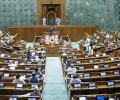
The deportation of Indians from the United States, deaths in the Maha Kumbh stampede and the joint Parliamentary committee report on the Waqf bill were among the issues that led to heated exchanges and some disruptions in an otherwise smooth first part of the Budget session that ended on Thursday.

S&P Global Ratings on Wednesday said the impact of the US reciprocal tariff will be limited on India as the economy is domestically oriented with less reliance on exports. YeeFarn Phua, Director, Sovereigns and International Public Finance Ratings, Asia-Pacific S&P Global also said India will clock a 6.7-6.8 per cent GDP growth over the next two years.

'Rhetoric and chest-thumping are running high on India's recent growth record.'
'But will the giant waves developing elsewhere allow us to sail smoothly into fair winds?' asks Debashis Basu.

The Rs 2,000 note withdrawal decision and response to it so far suggest that the move can help boost FY24 GDP growth to beyond 6.5 per cent estimated by the RBI, a report said on Monday. The real GDP growth for the first quarter of FY24 will come at 8.1 per cent with an upward bias and the Reserve Bank of India's 6.5 per cent estimate can also be exceeded, economists at the country's largest lender SBI said. "We expect Q1 FY24 GDP growth at 8.1 per cent with an upward bias due to the impact of Rs 2000 note withdrawal event...this reinforces our projection that FY24 GDP could be higher than 6.5 per cent, basis the RBI estimate," a note said.

Global fund managers witnessed one of their largest-ever declines in assets under custody (AUC) during the ongoing correction in the Indian markets, as stocks came under pressure from foreign outflows and the weakening rupee.

The size of India's middle class will nearly double to 61 per cent of its total population by 2047, from 31 per cent in 2020-21, as continuing political stability and economic reforms with a sustained annual growth rate of between 6 per cent and 7 per cent over the next two and half decades will make the country one of the largest markets in the world. The findings are part of a report released on Wednesday by the People Research on India's Consumer Economy (PRICE) and India's Citizen Environment, a not-for-profit think tank. The report titled, The Rise of India's Middle Class, is based on an analysis of primary data collected by PRICE through its pan-Indian survey.

American brokerage BofA Securities on Friday said the Indian economy continues to be "weak", pointing to activity indicators tracked by it. On the positive side, the brokerage said credit demand is bottoming out and the real lending rates adjusted for wholesale price inflation are falling. It can be noted that there has been a slew of reports lately about a stronger recovery being underway after the jolt caused by the pandemic.
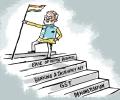
India's GDP expanded 13.5 per cent in the April-June quarter, the quickest pace in a year, to retain the world's fastest growing economy tag but rising interest costs and the looming threat of a recession in major world economies could slow the momentum in the coming quarters.

Equity benchmark indices are facing massive corrections, with the NSE Nifty declining over 14 per cent from its lifetime high hit in September last year due to several negative triggers like stretched valuations, foreign fund exodus, disappointing quarterly earnings and rising global trade tensions dragging markets lower. The BSE benchmark Sensex hit its record peak of 85,978.25 on September 27 last year, and the Nifty also reached a lifetime high of 26,277.35 on the same day.

Only one of the three drivers of the economy has performed in the way it should: government spending grew at 15.6 per cent, reports Abhishek Waghmare.

Since Sanjay Malhotra took office as governor in December, the Reserve Bank of India (RBI) has adopted a more accommodative stance, which bodes well for banking and the economy as they navigate a growth slowdown, according to analysts.
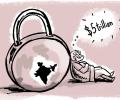
India's growth and success is guaranteed, he said propagating his idea of making the country self-reliant by cutting imports.

'Spending by the middle class is limited with a focus on savings. However, there is buoyancy at the top-end.'

India maintains "high" import duties on a wide range of American goods such as agricultural items, drug formulations, and alcoholic beverages, besides imposing non-tariif barriers, a US report has said. A day before announcing reciprocal tariffs, the US Trade Representative (USTR) released the 2025 National Trade Estimate (NTE) Report on March 31.

Investors should tilt their portfolios towards domestic-facing defensive sectors, which should help provide stability and shield them from geopolitical and tariff risks.
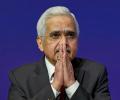
Outgoing Reserve Bank Governor Shaktikanta Das said on Tuesday that restoring inflation-growth balance is the most important task ahead of the central bank. Addressing a press conference on his last day as the central bank chief, Das said his successor will have to navigate the changing world order, effectively deal with cyber threats, and focus on harnessing new technologies.

Budget 2025-26 delivers a carefully calibrated strategy-stimulating demand and investment while keeping fiscal discipline intact. In an environment marked by global trade disruptions, and a softening in urban consumption, Finance Minister Nirmala Sitharaman has taken a measured approach.

Fitch Ratings on Tuesday raised India's growth forecast for the current fiscal to 7.2 per cent, from 7 per cent projected in March, saying elevated consumer confidence will drive spending, besides increased investments. In June update to its global economic outlook report, Fitch said it expects inflation to decline to 4.5 per cent by end of this year and RBI to cut policy interest rates by 25 basis points to 6.25 per cent.

'If you compare the data from 2017 and 2023 of the US imports from the world and China, you will see that the US was a complete loser in the trade war, and China was a complete gainer.'

While India won't be immune to global spillovers, we need to create the macro preconditions for sustained growth. Policy agility, prudence, and resilience will be key, suggests Sonal Varma.
'Binary fission will happen -- startups will lead to more startups.'

'No retaliatory tariffs now. You can retaliate after a few months.' 'Today, there is no need to retaliate because it is a question of long term benefits.'

'The pipeline of new industrial projects is the best I've seen in the last 10 years, and it looks solid enough to sustain for at least a few quarters,' points out Naushad Forbes, adding, 'It is only when we get back to the same labour force participation we saw before Covid that the economy will have truly recovered.'
